Boba agent & MCP server
One of the first MCP servers for cross-chain agentic trading.
- Stack
- GoTypeScriptMCPpgvectorOpenRouter
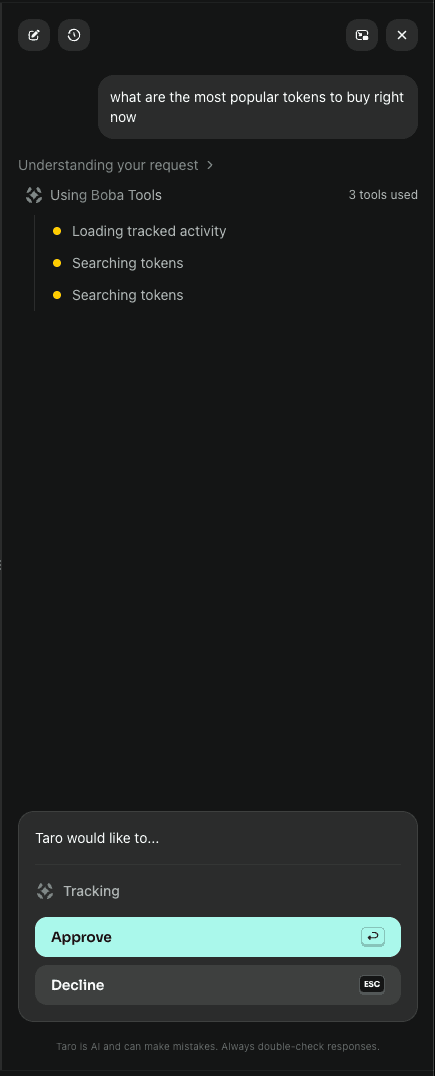
Taro, Boba's agent, is what makes it more than a trading terminal: you can ask it to research a token, check a wallet, or place an order, and it does it with the same engine the app uses.
I built one of the first MCP servers for cross-chain agentic trading, and the Go agent runtime on top of it. Any MCP client, like Claude, can use the same tools.
Decisions
Models get shaped data, not raw APIs
Raw API responses are written for programs, and every extra field costs tokens and attention. So every response is reshaped and enriched before the model sees it. Tracked wallets went from 112KB to about 1.2KB, and token spend dropped around 60% versus the Helius, GMGN and Codex MCP servers.
Fewer tools, no detours
The first tool set sent the model on detours: one tool existed only to convert an amount for another, and a trade needed a five-step guide. If a tool needs a manual, the design is wrong. I consolidated everything into 21 action-based tools, one per domain.
What I built
- An agent loop that streams over SSE, calls MCP tools, and keeps long-term memory in pgvector.
- Consolidated dozens of narrow tools into 21 action-based tools across trading, portfolio, discovery, orders, perps, predictions and research, so the model has fewer, clearer choices.
- Data is compacted and enriched before it reaches the model, cutting token spend by 60% compared with the Helius, GMGN and Codex MCP servers.
- Security built for an agent that can move money: approval gates, read-only delegate allowlists, single-use tool-call IDs bound to their owner, per-user limits, and fail-closed auth.
- An inference gateway with credits, subscriptions and onchain payment verification.